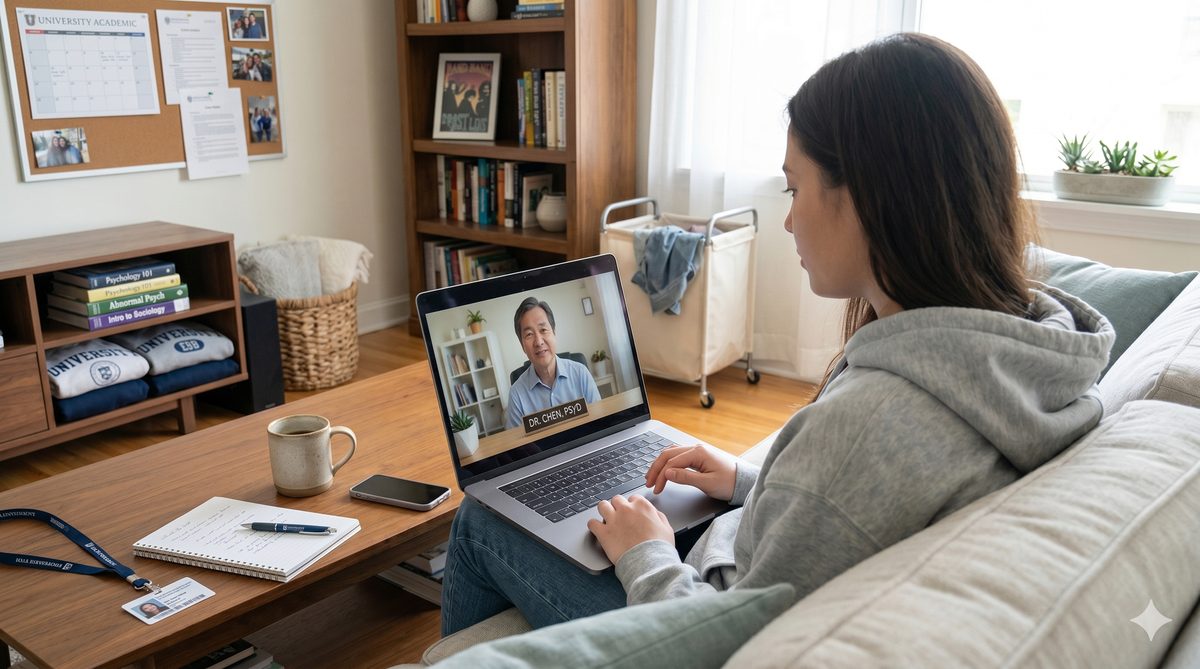
A lot of college students are doing fine on the outside and not fine underneath. The grades are still there. The friend group is still there. The internship is on track. But sleep is harder than it should be. The social pressure is louder than it used to be. And something has been off since the second half of last semester.
If that is roughly the picture, this page is for you, or for a parent reading on a student's behalf. I am Dr. France Frederick, a licensed clinical psychologist with my office in Fairhope, Alabama. For students elsewhere in the state, I offer secure video sessions that work around a class schedule and follow you home for breaks and the summer.
What I see most often in college clients
The specifics differ. The patterns repeat.
The performance-pressure spiral. You were the student who did well in high school without trying that hard. College is different. Suddenly the work is harder, the structure is gone, and the strategies that used to work do not. The anxiety shows up first as productivity (overpreparing, rechecking) and then as paralysis.
The quiet depression. Not the kind that keeps you in bed all day. The kind that lets you keep going to class while feeling almost nothing. Things that used to be fun are not. Friendships feel thinner. You are still functioning, and you do not quite know how to name what is wrong.
The relationship reckoning. First serious relationships, first real breakups, first time noticing patterns from your family showing up in your romantic life. College is when a lot of this lands, and it lands harder than people expect.
Family conflict at a distance. Living away from home changes the relationship with your parents in ways you cannot always control. The phone calls feel different. Visits home feel different. The questions you used to be able to avoid now have to get answered.
Identity work. Figuring out who you are when no one from home is watching, and figuring out who you want to be on the other side of college, is one of the actual jobs of this stage of life. It is also exhausting, and it is reasonable to do some of that work with a therapist.
How telehealth works
A secure browser link is sent before each session. No app to download. The technology is straightforward. You need a private space and a stable internet connection. A laptop works better than a phone. A pair of headphones helps.
Sessions are fifty minutes. The first session is ninety minutes so we have time to understand what is bringing you in and what you are hoping to work on. Most students start weekly and shift to every other week as the work progresses.
Telehealth is licensed at the state level, which means I can see clients located anywhere in Alabama. If you are in Alabama for school but your permanent residence is in another state, we can work that out during the consultation.
A note for parents
If you are reading this on behalf of a student in your family, two things worth knowing.
First, students who choose to come to therapy do better than students who are pushed into it. A short conversation between us, with the student in the room, is usually a better starting point than a referral made over their head.
Second, the work is theirs, not yours. Once a student is eighteen, the sessions are confidential to them, with the standard legal exceptions. That is a feature, not a bug. The trust required for therapy to work depends on it.
If your student is willing to schedule a phone consultation, I am happy to talk with them about whether the practice is the right fit.
Why work with a clinical psychologist
The title "therapist" covers a wide range, from master's-level counselors to doctoral-level psychologists. Both can provide good care. The depth of training is different.
A doctoral-level clinical psychologist has done thousands of supervised clinical hours, doctoral coursework in psychological science, dissertation research, and postdoctoral training. That depth matters when the picture is more complicated than it first appears: when anxiety might be trauma, when depression might be burnout, when what looks like a relationship issue is rooted in something older. It also means I can offer psychological assessment alongside therapy when assessment would clarify the next step.
For students whose campus counseling center has an appointment cap or a long waitlist, this practice is also a way to get continuity. The same therapist for the same problem, semester to semester, year to year.