You can be doing well by every external measure and still feel like something is quietly wrong. The work is handled. The family is taken care of. From the outside, no one would guess. Inside, the anxiety has been building, or the low feeling has stopped lifting, or a relationship has gone somewhere you do not know how to talk about.
I am Dr. France Frederick, a licensed clinical psychologist. My office is in Fairhope, on the Eastern Shore, and my telehealth license covers the entire state of Alabama. You can do real psychological work with the same doctoral-level psychologist whether you live in Birmingham, Huntsville, Montgomery, Mobile, or a small town two hours from the nearest practice that ever felt like a fit.
Therapy with a psychologist, not an app
Most online therapist services you have probably seen advertised pair you with whoever is available and move you between counselors. This is not that. You work with me, the same person, every session. I am a doctoral-level clinical psychologist with more than twenty years in practice, not a name pulled from a queue. When the picture turns out to be more complicated than it first looked, which it often does, that depth is the difference between managing a symptom and understanding what is underneath it.
What we can work on by video
Most of what happens in my office happens just as well over a secure connection.
Individual therapy. Anxiety that follows you into rooms it has no business being in. Depression that lets you keep functioning while feeling almost nothing. The particular weight of being the person everyone else relies on.
Couples and marriage work. Two people can join from the same room or from two different places in the state, which removes the scheduling problem that derails a lot of couples therapy before it starts. The work itself is unchanged: looking honestly at the pattern, not just at the partner.
Life transitions. A career change, a divorce, a loss, or the specific disorientation of a season when several hard things arrive at once.
How telehealth works
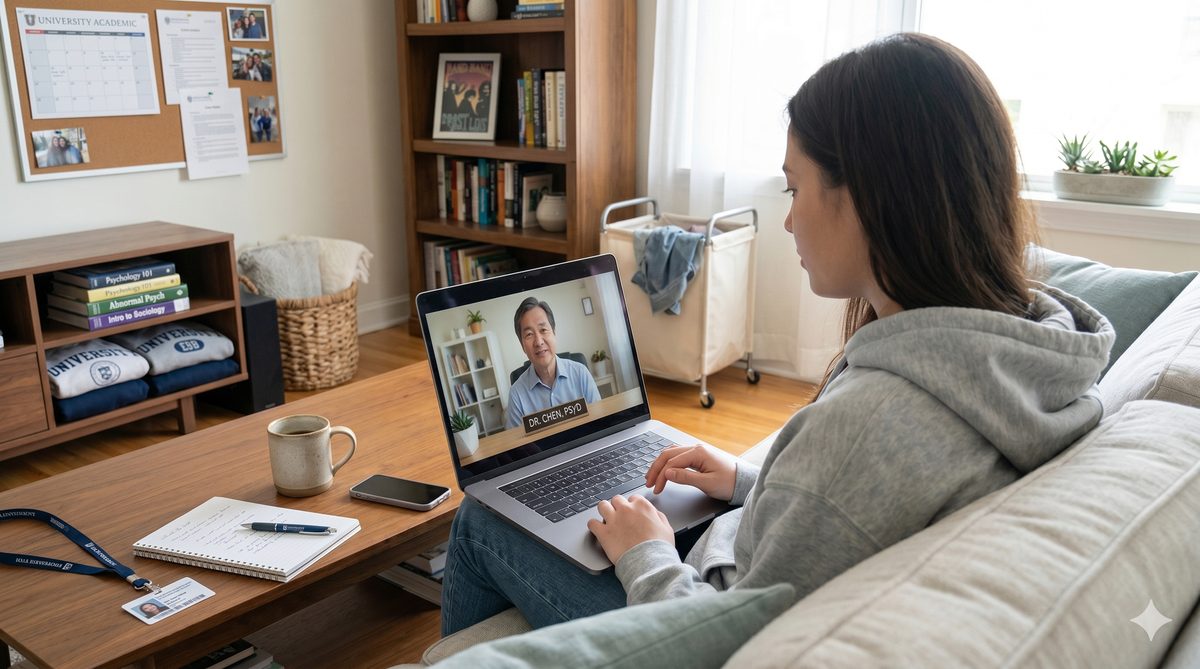
A secure browser link arrives before each session. There is no app to download. You need a private space, a stable connection, and ideally a laptop and headphones rather than a phone.
Sessions are fifty minutes. The first session is ninety, so there is time to understand what is bringing you in and what you want to be different. Most clients begin weekly and move to every other week as the work takes hold.
Because telehealth is licensed at the state level, I can see anyone physically located in Alabama. We confirm your location at the start of care. That is a licensing requirement, not a formality.
Anywhere in Alabama
Distance is the reason a lot of good therapy never happens. The right psychologist is ninety minutes away, the schedule does not allow it, and the search quietly ends. Video removes that. Clients meet with me from Baldwin County and Mobile, from Montgomery and Birmingham, from Huntsville and the Shoals, from college towns like Tuscaloosa and Auburn. Where you are matters less than whether the fit is right.
If you are a college student in Alabama, there is a page written for exactly that situation: online therapy for Alabama college students.
Insurance and fees
I file claims with Blue Cross Blue Shield of Alabama as a non-participating provider. Whatever BCBSAL pays is credited against the full session fee, and you are responsible for the difference. For all other carriers I am out of network. You pay the full fee at the time of service and can submit a superbill, provided on request, for any out-of-network reimbursement your plan allows. Specific fees are discussed during the first phone call.
Why a clinical psychologist
The word therapist covers a wide range, from master's-level counselors to doctoral-level psychologists. Both can do good work. The training is not the same. A clinical psychologist has completed doctoral coursework in psychological science, thousands of supervised clinical hours, dissertation research, and postdoctoral training. That depth matters when anxiety turns out to be trauma, when depression turns out to be burnout, when what looked like a relationship problem is rooted in something older. It also means I can bring psychological assessment into the work when assessment would clarify the next step.